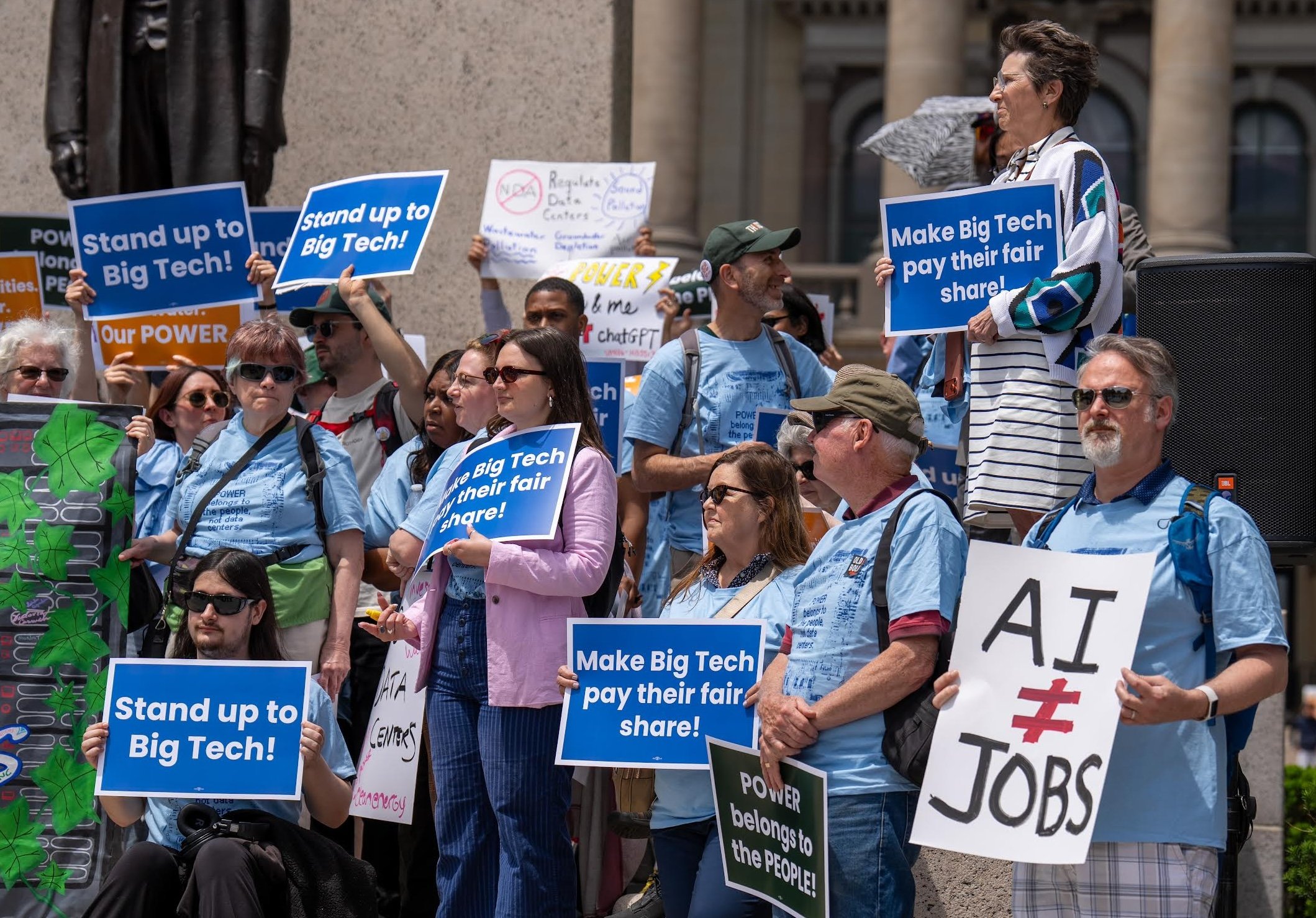
Protestors call for data center accountability at POWER Act Lobby Day in Springfield, Ill.
November 2, 2026
December is around the corner, and we’re rushing into yet another PJM capacity auction with no clear end in sight to the region's electricity affordability crisis.
After years of mounting public pressure, PJM Interconnection finally filed its IRAS plan to hold data centers accountable for their costs to the Federal Energy Regulatory Commission (FERC) in August. On Oct. 9, though, the Commission rendered the majority of PJM’s plan unactionable.
It was a decision that directly contradicted the White House Ratepayer Protection Pledge, and left consumers exposed to yet another year of punishing electricity prices.
The FERC ruling took the wind out of the proposal’s sails—and with it, communicated loud and clear that, despite unmet promises from the White House and Big Tech that the public wouldn’t foot the bill for data centers’ electricity and infrastructure costs, the federal government would not come to anybody’s rescue.
Yet FERC still has an opportunity to stand by its promises—and its legal requirement—to protect the public.
The Commission has repeatedly, and without subtlety, called out PJM for failing to manage the dual crisis of meeting unprecedented data center demand and bringing down record-setting electricity prices. For the 67 million people who rely on the PJM grid, Big Tech’s power-hungry data centers have meant not only the threat of blackouts, but unmanageable electricity bills. In the last four auctions alone, data centers have cost consumers an alarming $29.4 billion.
It’s a situation that has put PJM’s complicated and often anti-consumer decision-making structure under renewed scrutiny, leading many to question whether the organization is, in its current form, fit to address the crisis. So much so that in July, FERC gave PJM an ultimatum: Reform your governance process by the end of September, or we will do it for you.
The governance proposal that came out of the FERC-led mediation process, though, was doomed from the start. PJM’s stakeholder process is dominated by big energy companies who actively oppose handing more power to States and prioritizing the public interest. The governance proposal ultimately approved by PJM Members reflects the structural bias of PJM’s decision-making process. PJM’s Members (minus the vast majority of consumer advocates) voted overwhelmingly to wield veto power over the States, whose mission to protect consumers from skyrocketing electricity prices is fundamentally at odds with the dogma of maximizing shareholder value.
Now, FERC must stand with the public and call for an overhaul of PJM’s governance–rejecting the self-interested Members’ proposal and imposing requirements for formalized state roles. With the Commission’s ruling on IRAS punting protections from data center costs to the states, PJM governance reform that gives states actual power is more essential than ever. States must have a stronger voice at PJM and meaningful mechanisms to advocate for the interests of everyday people, or PJM’s dysfunction will continue to undermine affordability and reliability for the entire region.
FERC faces several key question as it considers reform proposals on data centers and governance:
How, exactly, can the Ratepayer Protection Pledge work if the Commission keeps rejecting PJM’s attempts to manage data center costs, as it did with IRAS?
Will FERC step up, while there's still time, to enable the necessary action to cope with data centers—not just any “customer,” but one with magnitude and expense unlike any other?
And will FERC make meaningful changes to PJM governance so decisionmakers are accountable to the public, not to shareholders?
We deserve clear, decisive answers from FERC. But 67 million customers who are now in their second year of painfully high electricity bills can’t afford to wait much longer.
